
SSD Data Recovery
If you are encountering SSD problems, such as it suddenly stopping working, disappearing from your computer, or becoming inaccessible, don’t panic; we can still access your data. At mService Sweden AB, we provide SSD data recovery in Stockholm and all the surrounding suburbs, no matter the damage.
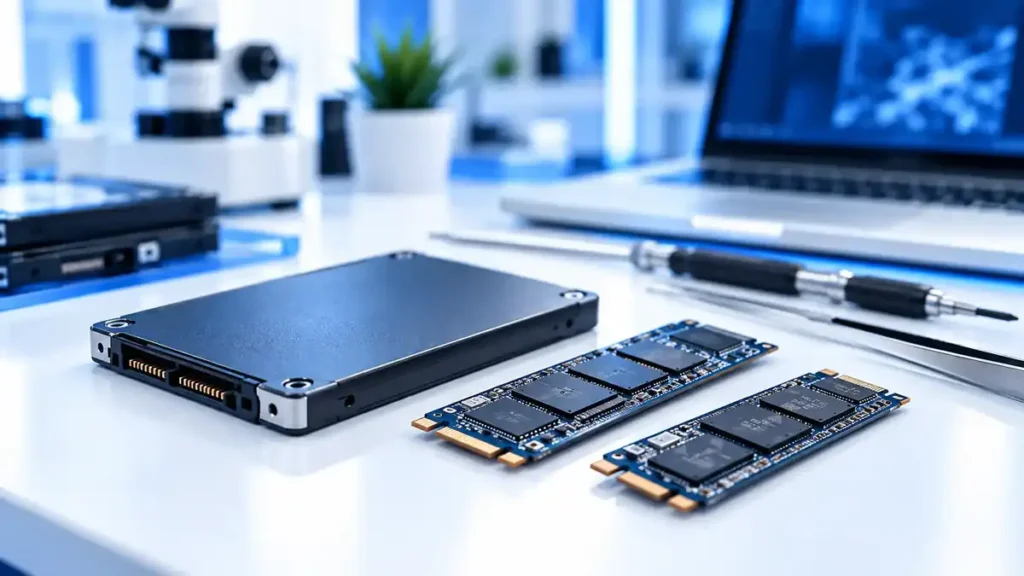
Our 25 years of experience in data recovery have prepared us for all scenarios, and with our high-tech equipment, we secure your data. We help individuals, businesses, and organizations recover valuable files from SATA, M.2, and NVMe SSDs.
- Over 25 years of experience
- 5,000+ devices handled
- PC-3000 technology
- Confidential data handling
Professional SSD Data Recovery in Stockholm
An SSD can fail at any point without any sound or a prior warning.
We have seen examples where it has suddenly disappeared from the computer, stopped responding, displayed the wrong capacity, or prevented the operating system from starting.
Our skilled technicians use high-tech equipment to examine the SSD to determine whether the problem lies with the controller, firmware, memory chips, electronic components, or the file system. We then explain the available recovery options before beginning the work. If the drive itself needs to be restored to working order, see our SSD repair service.
Controller
Communication between the drive and the computer
Firmware
The internal software that manages the SSD
NAND memory chips
Where your files are physically stored
Electronic components
Power circuits, circuit board and connector
File system
The structure that organizes your files
Recovery options are explained before any work begins.
SSD Problems We Can Help You Recover Data From
We handle logical, electronic, and physical SSD failures, including:
- SSDs that are not detected by a computer
- Accidentally formatted SSDs
- Deleted files and partitions
- Burnt or short-circuited SSDs
- Damaged connectors or circuit boards
- Firmware and controller failures
- SSDs with bad sectors or unreadable memory blocks
- SATA SSD failures
- M.2 SSD failures
- NVMe SSD failures
- Computers that no longer start because of storage failure
- SSDs affected by liquid, impact, or electrical damage
If your SSD contains important data, stop using it as soon as a problem appears. Continued use, repeated restarts, formatting, or recovery software may overwrite recoverable information.
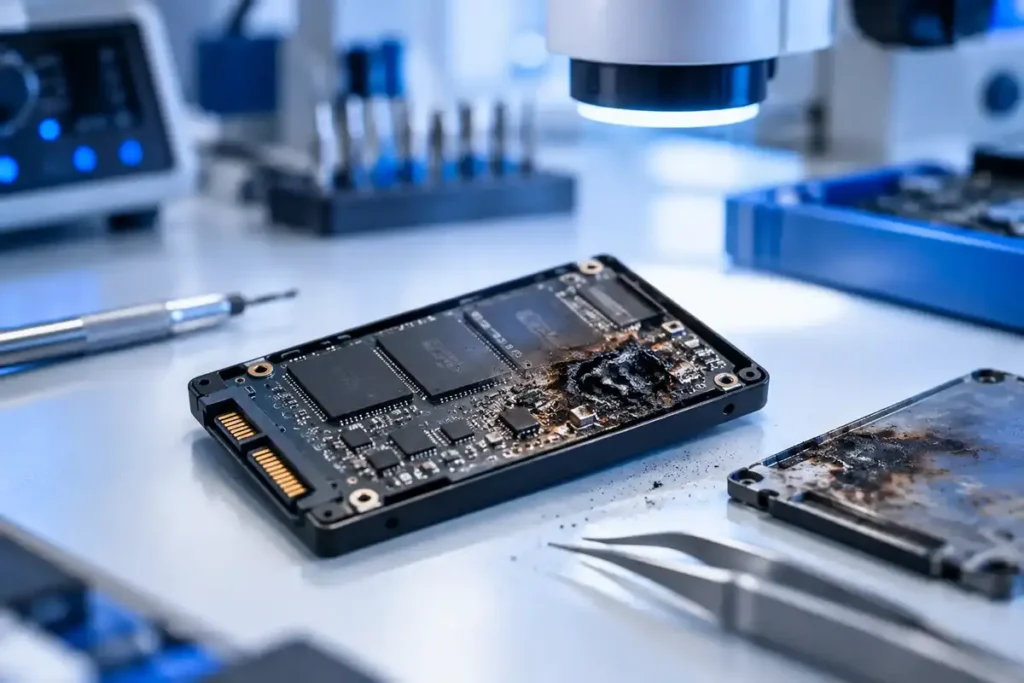
Data Recovery from a Burnt SSD
An electrical surge or a faulty power supply, a short circuit, or overheating can damage the electronic components of an SSD. Sometimes the drive will smell burnt, get really hot, or just stop appearing on the computer.
Our technicians will use special diagnostic tools to determine why the SSD is not responding and the safest way to recover it.
Don’t plug in a burnt SSD. Reapplying power can cause further damage to the controller, circuit board, or NAND memory chips.
Common causes
- Electrical surge
- Faulty power supply
- Short circuit
- Overheating
Warning signs
- Burnt smell
- Drive gets very hot
- Stops appearing on the computer
Recovering Data from a Formatted SSD
Data recovery from a formatted SSD may be possible, but the result depends on how the drive was formatted and whether new data has been written to it.
About TRIM: Modern SSDs commonly use the TRIM command to remove information about deleted data. Once TRIM and internal garbage collection have erased the relevant memory blocks, recovery may no longer be possible.
For the best chance of recovering a formatted SSD:
- Stop using the drive immediately
- Do not reinstall the operating system
- Do not create new partitions
- Do not save new files
- Do not run recovery software directly on the affected SSD
- Disconnect the drive and request a professional assessment
An examination is necessary before anyone can honestly determine whether the files remain recoverable.
Data Recovery for an Undetected SSD
An SSD that is not detected may have a faulty controller, damaged firmware, failed electronic components, a damaged connector, or problems with the NAND memory.
The drive may not appear in:
- BIOS
- Disk Management
- Finder
- Disk Utility
- The operating system
It may also appear with an incorrect name or storage capacity. Our technicians use specialist diagnostic equipment to identify why the SSD is not responding and determine the safest recovery method.
Recovering an SSD with Bad Sectors
SSDs do not develop mechanical bad sectors in the same way as traditional hard drives. However, their NAND memory can develop damaged or unreadable blocks, leading to:
- Freezing
- Read errors
- File corruption
- Reduced performance
Continuing to use a failing SSD can increase the number of unreadable blocks. Our recovery process focuses on safely reading the available memory while minimizing further stress on the device.
We then reconstruct the recoverable files from the retrieved data.
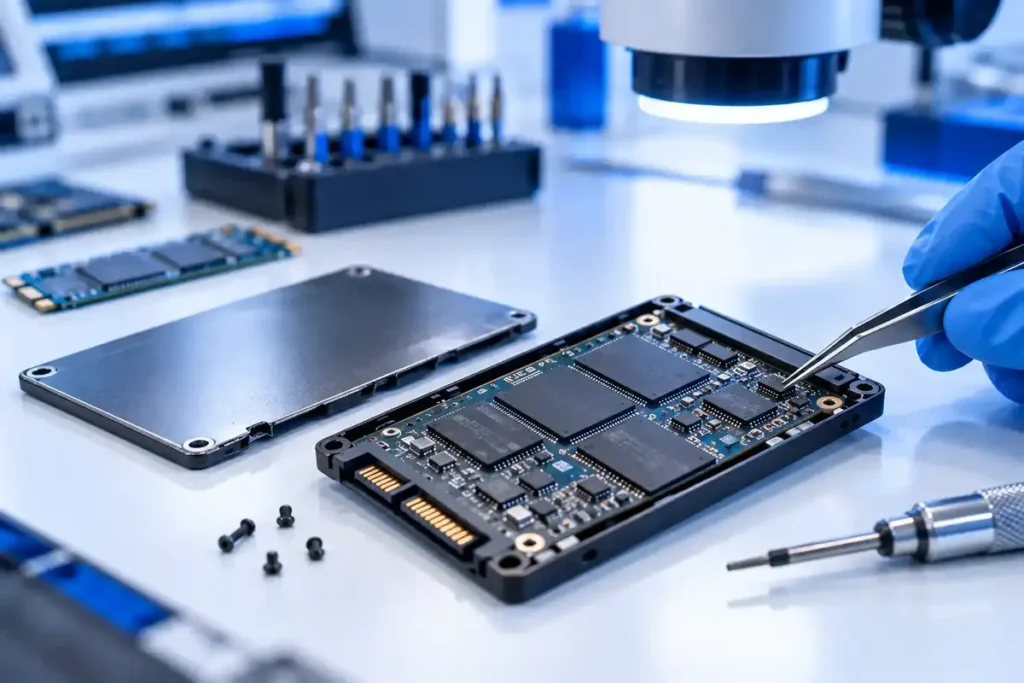
Recovering Data from a Physically Damaged SSD
Physical or electronic damage can prevent an SSD from communicating with the computer even when its memory chips still contain data. We assess SSDs affected by:
- Electrical surges
- Short circuits
- Liquid damage
- Impact damage
- Broken connectors
- Overheating
- Damaged circuit boards
- Controller failure
- NAND memory degradation
The correct method depends on the SSD model, controller, encryption, and type of damage. For this reason, a professional diagnosis should always precede any recovery attempt.
M.2 SSD Data Recovery
M.2 describes the physical form of a compact SSD, but M.2 drives may use either the SATA or NVMe interface. Identifying the correct type is important because their architecture and recovery methods differ.
M.2 SATA
SATA interface
M.2 NVMe
PCIe / NVMe interface
We provide M.2 SSD data recovery for drives affected by controller faults, firmware issues, damaged connectors, unreadable memory, accidental formatting, and file system corruption.
Contact us with the SSD model and a description of what happened. Our team will advise you on the safest next step.
NVMe SSD Data Recovery
NVMe SSDs provide high performance, but their complex controllers, firmware, encryption, and memory-management systems can make data recovery particularly challenging.
An NVMe SSD may:
- Fail suddenly
- Disappear from the system
- Report an incorrect capacity
- Prevent the computer from starting
Our specialists use advanced diagnostic tools and professional recovery methods to assess failed NVMe drives and recover accessible data where technically possible.
Stop Using the SSD and Request an Assessment
If the missing files are important, avoid trial-and-error recovery attempts.
Do not format, initialize, repair, or repeatedly reconnect the SSD. These actions can change its condition and reduce the possibility of successful recovery.
Contact mService Sweden AB and tell us:
- The SSD brand and model
- The device in which it was installed
- What happened before the failure
- Whether the SSD is detected
- Whether it was formatted or overwritten
- Which files are most important
Why Choose mService Sweden AB for SSD Data Recovery?
SSD recovery requires more than ordinary file-recovery software. It demands technical knowledge of controllers, firmware, NAND memory, encryption, and file systems.
Customers choose mService Sweden AB because we provide:
More than 25 years of professional data recovery experience
Experience with over 5,000 storage devices
Specialist SSD diagnostics
PC-3000 data recovery technology
A Class 100 cleanroom for cases requiring a controlled environment
Support for SATA, M.2, and NVMe SSDs
Clear information before recovery work begins
Secure and confidential data handling
Services for individuals, businesses, authorities, and organizations
SSD data recovery in Stockholm and throughout Sweden
Over 25 Years of Data Recovery Experience
mService Sweden AB has provided professional data recovery and electronic device services in Sweden for more than 25 years.
During this time, we have developed specialist knowledge of storage failures involving SSDs, hard drives, servers, RAID systems, NAS devices, mobile phones, and surveillance systems.
Our team combines practical experience with advanced equipment, including PC-3000 systems. This enables us to investigate complex SSD failures while maintaining high standards of precision, security, and confidentiality.
25+
Years of data recovery experience
5,000+
Storage devices handled
PC-3000
Professional recovery systems
Class 100
Cleanroom for controlled recovery
Our SSD Data Recovery Process
We keep the process clear from the first assessment to the secure delivery of your recovered files.
Contact Us
Contact us and describe the SSD failure and the files you need.
Send the SSD
Deliver or securely send the SSD to our Stockholm laboratory.
Free Examination
Free examination to identify the fault and evaluate recoverability.
Clear Recommendation
Clear recovery recommendation with the expected cost and available options.
Professional Recovery
Professional SSD data recovery after receiving your approval.
Secure Delivery
Secure delivery of the recovered data with full confidentiality.
Advanced SSD Recovery Tools and Cleanroom Facilities
We use professional hardware and software designed for complex data recovery cases.
Our technical resources include PC-3000 systems for diagnosing and working with storage-device firmware, controllers, and memory-access problems. We also maintain a Class 100 cleanroom for recovery cases requiring controlled conditions.
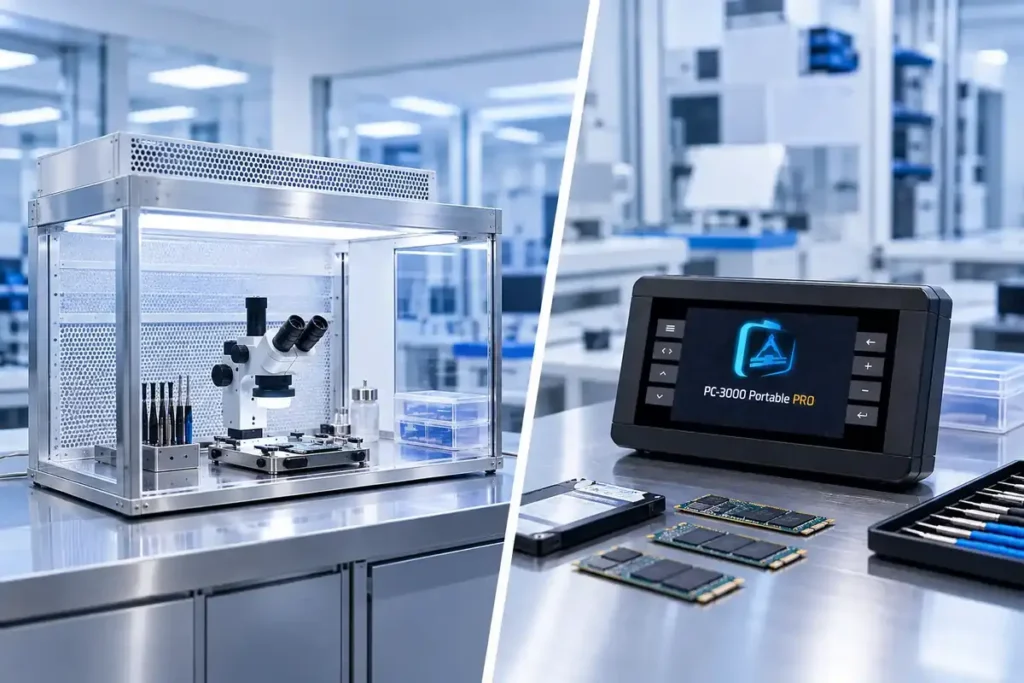
PC-3000 Systems
Diagnosis and work on firmware, controllers, and memory-access problems.
Class 100 Cleanroom
For recovery cases requiring controlled conditions.
Tailored Recovery Method
The exact recovery method is selected based on SSD architecture, damage, encryption, and the condition of the memory chips.
SSD Data Recovery Cost
The cost of SSD data recovery depends on the type of drive, the cause of failure, the level of damage, encryption, and the complexity of the required work.
A formatted SSD with a healthy controller may require a different process from a burnt NVMe SSD with electronic or firmware damage.
We begin with a free examination. After the assessment, you receive information about the fault, recovery options, and expected cost before deciding whether to continue.
What affects the price?
- Type of drive
- Cause of failure
- Level of damage
- Encryption
- Complexity of the work
Free examination. You receive the fault, recovery options, and expected cost before deciding whether to continue.
SSD Data Recovery in Stockholm and Nearby Areas
We primarily help customers from Stockholm and nearby areas, including:
- Kungsholmen
- Vasastan
- Norrmalm
- Östermalm
- Södermalm
- Bromma
- Solna
- Sundbyberg
- Nacka
- Lidingö
- Danderyd
- Täby
- Sollentuna
- Järfälla
- Huddinge
Customers elsewhere in Sweden can contact us for instructions on how to securely send an SSD to our laboratory.
Start Your SSD Data Recovery Case Today
A failed SSD does not always mean that your files are permanently lost. The right response in the first few hours can make a real difference.
Stop using the device and let our specialists examine the SSD before further damage or overwriting occurs.
Frequently Asked Questions About SSD Data Recovery
Can data be recovered from a completely dead SSD?
Recovery may be possible if the failure involves the controller, firmware, circuit board, connector, or another electronic component. The SSD must be examined before its recoverability can be determined.
Can you recover data from a formatted SSD?
Sometimes. The result depends on the type of formatting, subsequent use of the drive, TRIM activity, encryption, and whether new data has overwritten the original files.
Can data be recovered after TRIM?
If TRIM and garbage collection have already cleared the relevant memory blocks, the deleted data may be permanently unavailable. However, the SSD should still be professionally assessed because behavior varies between devices and failure scenarios.
Why is my SSD not detected?
Possible causes include controller failure, firmware corruption, electronic damage, connector problems, NAND degradation, or insufficient power. Avoid repeatedly reconnecting the SSD if it contains important data.
Do you recover data from M.2 SSDs?
Yes. We assess both SATA-based and NVMe-based M.2 SSDs. The recovery method depends on the interface, controller, encryption, and type of failure.
Do you recover data from NVMe SSDs?
Yes. We provide NVMe SSD data recovery for logical, firmware, controller, and electronic failures where recovery is technically possible.